Festivals, rituals and stories that mark the village’s calendar year.
Carrosio’s living calendar
In Carrosio, spirituality has never been confined within the walls of churches. Here, faith is communal, shaped by rituals that unite the village and the countryside, the sacred and the everyday. Even today, the liturgical calendar marks moments of gathering that renew an ancient bond between devotion, identity and the landscape.
A village of brotherhoods and processions
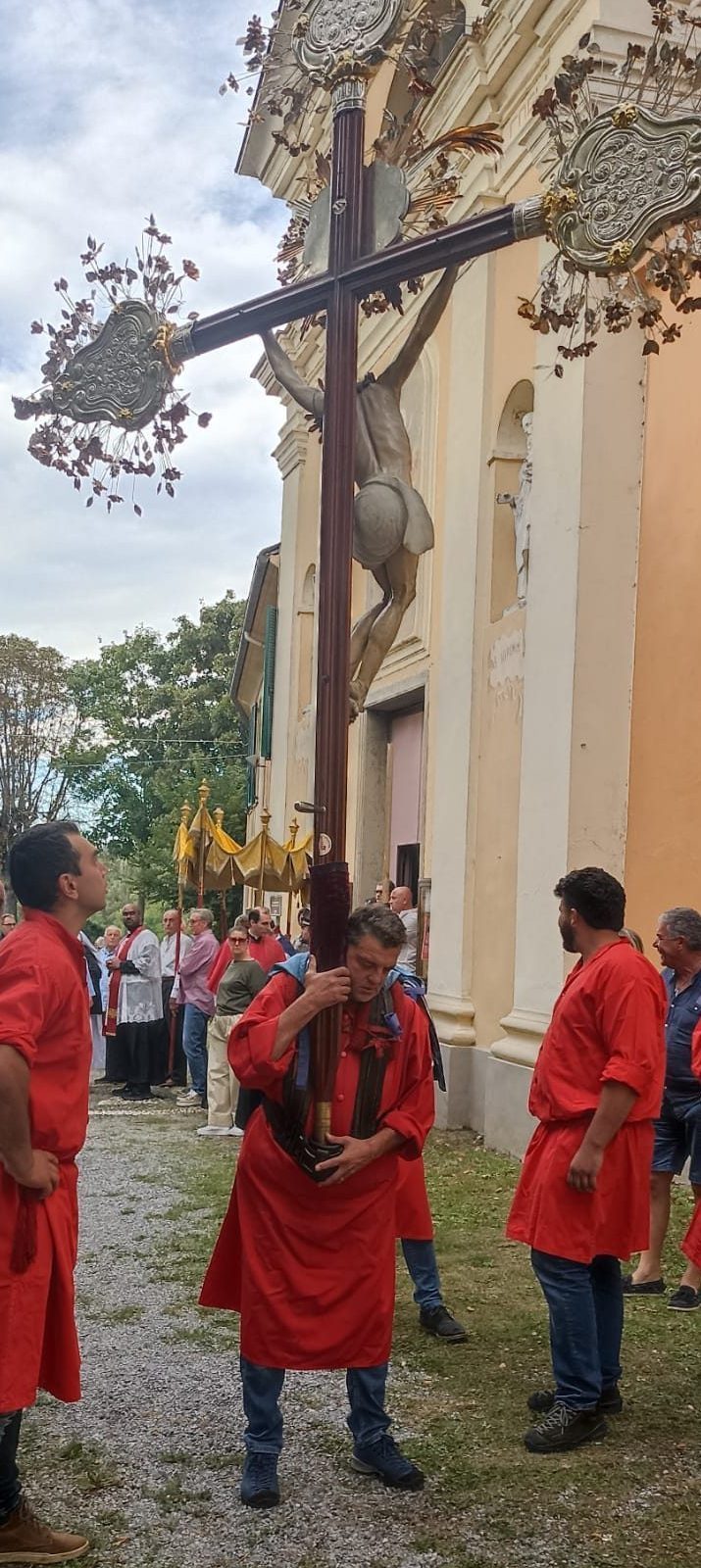
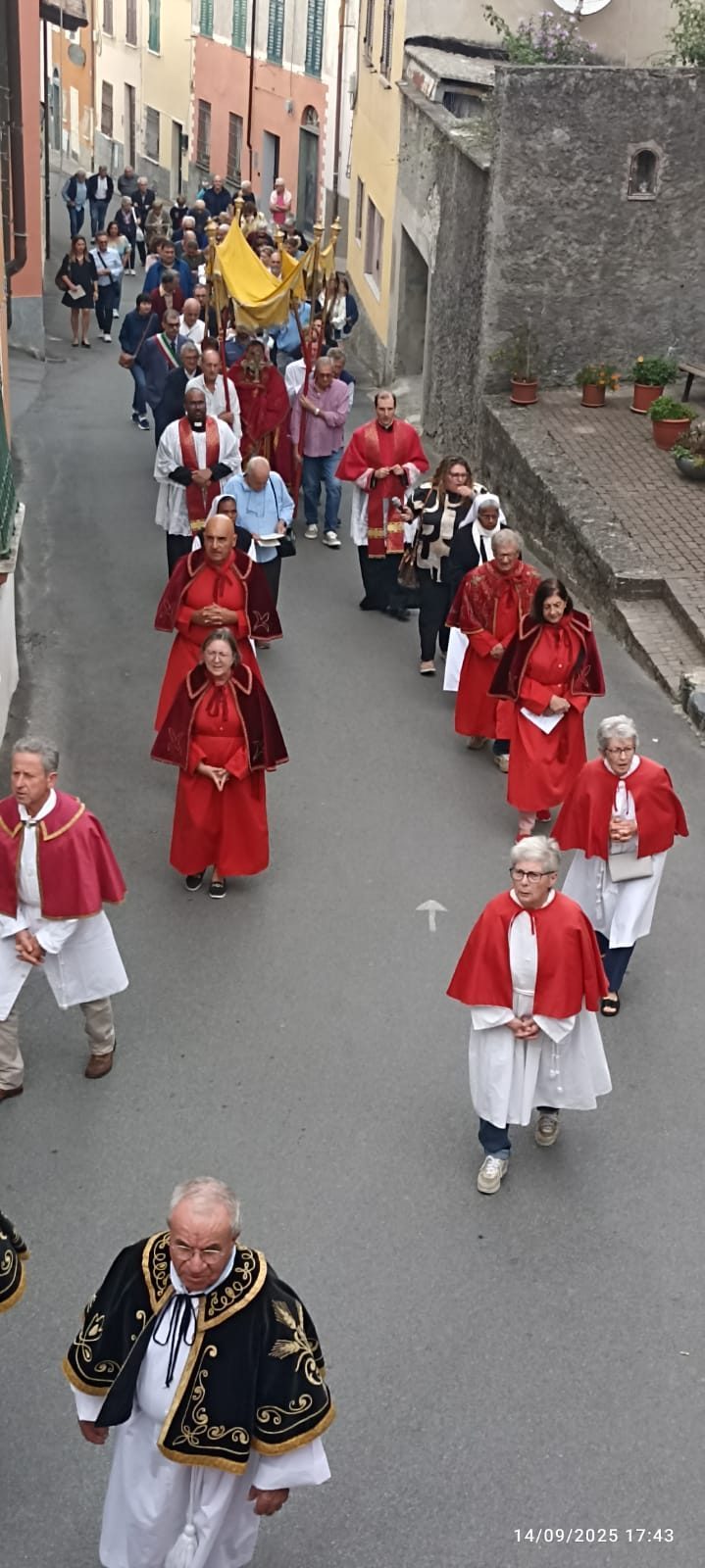
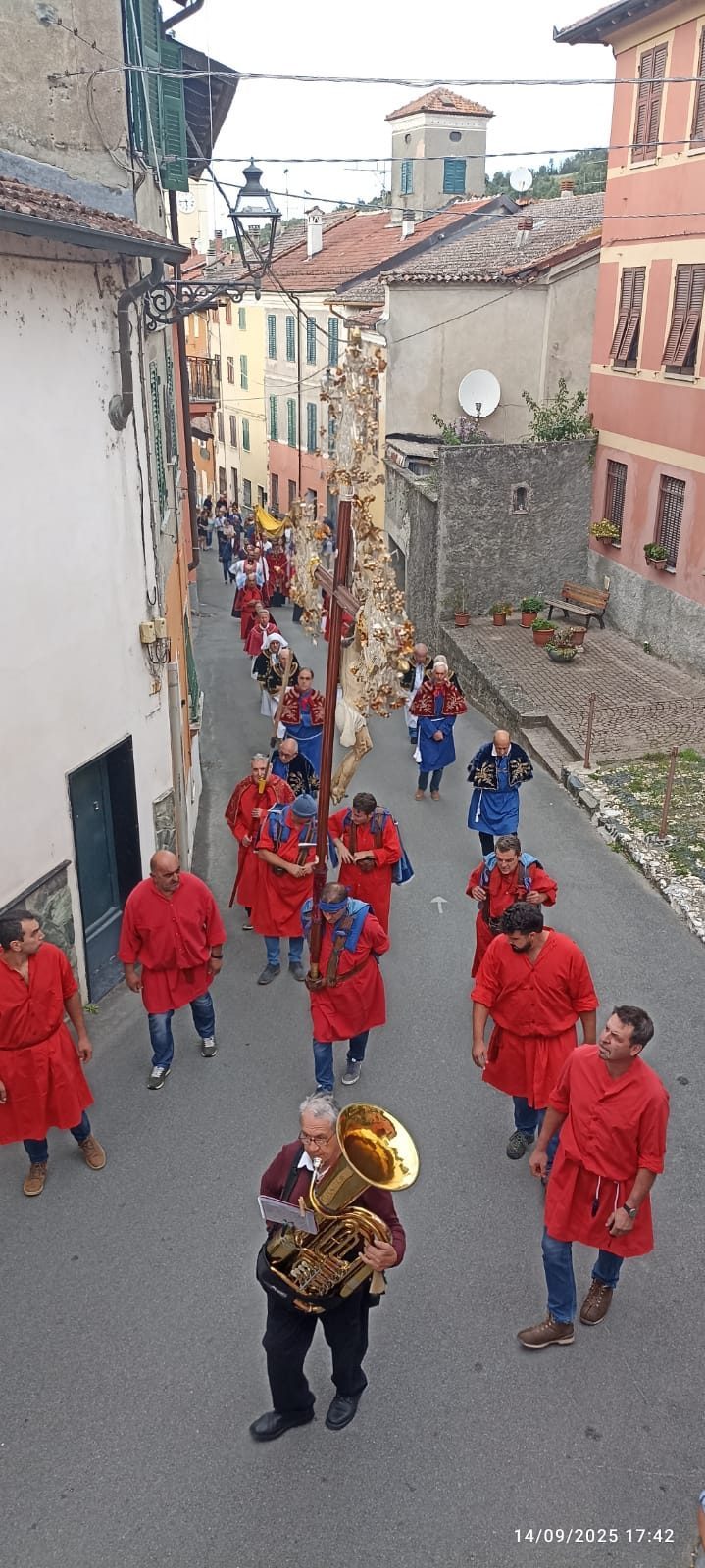
Since the 17th century, the brotherhood of the Holy Trinity has enlivened the religious life of the village, organising processions and festivals. The oratory attached to the parish church houses painted banners, processional staffs and statues that once paraded through the streets, accompanied by songs and communal prayers.
These objects, still in use today, are not merely liturgical furnishings: they are tangible symbols of a faith expressed through the movement of the body and the community, in the act of carrying and walking together.
The Ascension to Colle d’Aimero
One of the most deeply felt festivals is that of the Ascension, celebrated on the sixth Sunday after Easter. The community climbs in procession to Colle d’Aimero, where in 1915 a small chapel was erected using stones from the medieval castle destroyed by the Genoese in the 12th century. It is a ritual that combines historical memory and popular devotion: as one climbs the paths, one relives the bond between land, faith and community.
The Assumption and other festivals
On 15 August Carrosio celebrates its patron saint, the Assumption. It is the most important festival, bringing together families, emigrants and visitors. The village comes alive with religious celebrations and popular festivities, in a blend that evokes the atmosphere of festivals of yesteryear.
There are plenty of other festivals too: 3 May the Invention of the Cross, the eighth Sunday after Easter the Feast of the Trinity, and 14 September the Exaltation of the Cross. A packed calendar that marks the rhythm of village life well beyond the liturgical calendar.
Faith as a collective identity
In Carrosio, religious festivals are above all communal experiences. They are moments when differences are set aside, and everyone, from the youngest to the oldest, takes part in processions, masses, lunches and social gatherings. The landscape itself becomes an integral part of the experience: the paths, the hills, the churches and the oratories serve as a natural setting for the rituals.
Tradition that looks to the future
Today, these festivals are also opportunities for cultural tourism. They attract those who wish to discover the authentic roots of the area, participating not as spectators but as part of the ritual. In Carrosio, faith is not a spectacle: it is an invitation to share a community experience that stands the test of time.
Faith and folk traditions are the common thread linking Carrosio to its past and its future: a village that tells its story not only through stones and rocks, but through the collective steps of its processions and the simple power of its festivals.
Gallery